Cognitive science
The term cognition is derived from Latin word cognoscere which means “to know”, “to conceptualize” or “to recognize”. In science, cognition refers to some mental processes. These processes include attention, memory, producing and understanding language, managing emotions, solving problems and making decisions. The mental process of cognition is studied in various disciplines such as philosophy, linguistics, psychology, and computer science. Usage of the term varies in different disciplines.
Philosophical aspects
Canadian philosopher Paul Taggard defines cognitive science in the Stanford Encyclopedia of Philosophy as follows: “Cognitive science is the interdisciplinary study of mind and intelligence, embracing philosophy, psychology, artificial intelligence, neuroscience, linguistics, and anthropology.”
In the mid-1950s researchers in several fields began to develop theories of mind based on mental processes and computational procedures of the human mind. These researches marked the beginning of the cognitive science at the conceptual level. Its organizational origins are in the mid-1970s when the Cognitive Science Society was formed and the journal Cognitive Science began. Since then, more than seventy universities in North America, Europe, Asia, and Australia have established cognitive science programs. The central hypothesis of cognitive science is that thinking can best be understood in terms of representational structures in the mind and computational procedures that operate on those structures.
Most work in cognitive science assumes that the human mind has mental representations analogous to computer data structures, and information processing procedures similar to computational algorithms of the computer. Cognitive theorists have proposed that the mind contains such mental representations as logical propositions, rules, concepts, images, and analogies, and that it uses mental procedures such as deduction, search, matching, rotating, and retrieval.
Cognitive psychology
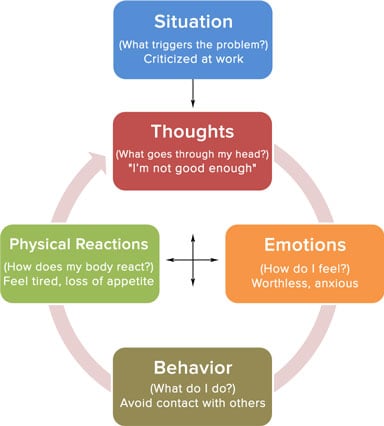
Cognitive psychology refers to the study of human mental processes and their role in thinking, feeling, and behaving. Perception, memory, acquisition of knowledge and expertise, comprehension and production o language, problem solving, creativity, decision making, management of emotional responses and reasoning are some of the broad categories of such study.
Experimentation lies at the heart of cognitive psychology, but mathematical models and computer simulations also play a role. Cognitive psychologists measure behaviour in laboratory tasks in order to reach conclusions about covert or unconscious mental processes.
Mind as information processor
Cognitive psychology often portrays the human mind as a processor of information. The mind computes answers to problems in a manner analogous to software of a computer. A digital computer represents an arithmetic problem such as 21+14 = on a symbolic code of zeros and ones according to an agreed convention. Then a software program processes those symbols according to the rules of addition, yielding the correct answer, 35. Similarly, as you read this problem and verified the answer, your mind interpreted the numbers and processed the information, the analogy between mental processes and computation has proved fruitful. This is called the information processing approach to cognitive psychology.
But the human mind does more than process information the way a computer would. Information technically refers to a reduction uncertainty about events. For example, consider the toss of a coin as an event with an uncertain outcome. If it comes up heads (or tails) then the uncertainty about the event has been reduced. Information has been transmitted. But the event is meaningless to you or another individual who receives the information.
Mind needs meaning
Now, suppose the coin is tossed again, but this time heads means you lose $500 or `25,000 and tail means you win $500 or `25,000. Are you ready for the toss? The outcome of the toss again reduces the uncertainty by one bit, but more important is that the toss now has meaning. It refers to other events that are significant to you.

Jerome Seymour Bruner, an American psychologist who has made significant contributions to human cognitive psychology, wrote in his book Acts of Meaning (1990) that meaning, not information in the mathematical sense, provides the focus of human mental attention. Bruner explains that what does not get structured narratively in our brain suffers loss in memory. ‘What gets stored in our memory is systematically altered to fit into our canonical representation of the world. If it cannot be altered, it is forgotten or highlighted in its exceptionality’.
A simple illustration concerns your ability to remember the items from two different lists given below. The first list in the upper row contains meaningless trigrams. The second list contains three lettered words, each of which refers to an object that you have experienced in the world and knows well. Study the trigram list for 30 seconds and then try to recall the items without looking. Then, do the same with the word list. Undoubtedly you will find the meaningful list much easier to memorize. Human mind lives and breathes through meaning. Our use of symbols to refer to objects, events, and other experiences; our efforts to understand why experiences occur as they do; and ultimately your hope to understand the purpose of our own existence all reflect the human need for meaning.
| Triagrams | WAQ | BEC | LOK | RIZ | TUZ | LUT | DOX | PEM | GAX | MIB |
| Words | PIG | LIP | CUP | PIT | RIB | CAT | DOG | LOG | BAT | MAP |
Evolution of mind
The discipline of cognitive psychology assumes that he mind and brain are systems that emerged through evolution. They have adaptive functions that enable us to succeed as reproducing organisms. The structures of mind and brain must be related to the adaptive functions, just as the opposable thumb of the primates is related to their ability to grasp objects. Systems of perceiving, remembering and thinking have evolved in a manner that allows us to adapt to our environment. The human mind did not emerge from the spotless laboratory of a computer scientist; rather it emerged from the messy forces of biological development as survival. Adaptations to the environment persisted in subsequent generations through natural selection.